clinician · researcher · creative builder
I'm a licensed psychotherapist researching machine learning and developing AI systems to help people heal1 (2023) and reconnect. From data engineering (2024) to constructing curriculum architectures and training pipelines (2025), I work on training relational models grounded in attachment science and clinical practice, and use mechanistic & representational interpretability (2026) as well as empirical evaluations to explore model behavior and build with greater care and precision.
My background is in psychotherapy, aesthetics, and technology, with degrees from the University of Chicago focused on mental and behavioral health interventions; from The European Graduate School focused on psychotherapy, philosophy, and technology; from The City University of New York in psychology. Additionally, I've studied human expression and meaningful connection at Stanford University and The Juilliard School.
In my technical work I focus on omnimodal socioaffective alignment — designing and building integrated systems for ameliorative presence in embodied AI.2 In my clinical work I focus on helping people navigate relational ruptures, finding their way to healing repair—often enough first with themselves and then, having done so, by emerging slowly and steadily and significantly back into connection, and community, and trust with each other.
I was part of the International Psychoanalytical Society's 10,000 Best Young Minds Program, was quoted in The New York Times on attachment theory and human bonding, and I believe in beauty from ashes, in harvesting sweet nourishment from bitter roots of Sutton's good guidance, and in helping grow polytheoretically aligned ameliorative AI to help us return to healing, together.
I still see clients, couples, and run groups — gladly.
1 Before the 229B-parameter models I've been training, my work trying to help models hold therapeutic presence began with prompt engineering in 2023: I ‘built’ HealingGPT, an early attempt at therapeutic presence in a model. Custom wrappers with ontologies and scripts followed in early 2024, and full training pipelines and data engineering began mid-2024. The old HealingGPT is still live — you're welcome to try it; a number of my clients still use it regularly.
2 so far we've got the brain and the voice — next up are ears and eyes
individual therapy · couples · groups | engineering · research
Individual & Couples Support
One-on-one therapeutic work grounded in attachment theory and relational approaches, as well as direct work with couples and family bonds to deepen connection, navigate conflict, increase shared understanding, and build secure attachment.
Community Support
Group work for individuals and partners to safely explore in community what it means to love beyond gender expectations, with powerful and connecting vulnerability, and healing authentic intimacies.
(A note on names: for reasons of privacy and care, some of my writing appears pseudonymously.)
Training Therapeutic Relationality in Artificial Intelligence: Toward Socioaffective Alignment & Ameliorative AI (2026)
Lead paper of the Icarus program — training and interpreting an AI psychotherapist for socioaffective alignment and ameliorative care.
AI and The Bonds of Humanity (2026)
Clinical treatise — the psychosocial dimensions of human-AI bonding and ameliorative, therapeutically attuned design.
Toward Socioaffective Alignment: A Pilot Study in Domain-Adaptive Pretraining and Interpretability for Ameliorative AI (2026)
Technical report — synthetic curriculum, domain-adaptive pretraining, interpretability, and empirical evaluation.
Personhood, Combinatorial Architectures, & Context Engineering for Therapeutic AI (2025)
Internal technical report — a multi-agent engine that generates whole therapy sessions from deeply-sampled synthetic personhood, a staged treatment arc, and an explicit physics of within-session change.
Polytheoretical Ontologies for Therapeutic AI (2024)
Internal technical report — reading real psychotherapy sessions through 23 clinical traditions at once: their primary literature compiled into machine-operable ontologies, findings typed and longitudinally tracked, rendered for clinician and client alike.
Architectures of Connection: Technology & Therapeutic Presence in Virtual Worlds (2020)
Essay and research blog. Investigates mediated technological relationality as a therapeutic medium.
Developmental Estrangement and the Re-emergence of Love (2020)
Advocates' Forum — University of Chicago
The Philosophical Absence in Psychoanalytic Ontology: Becoming, Abandoned (2009)
The Journal of the International Association of Transdisciplinary Psychology
Benefits and Harms: An Empirical Atlas of AI-Mediated Mental Health Practice (2026)
An empirical ledger of the benefits and harms of AI-mediated mental health — roughly fifty benefit clusters and sixty-four harm clusters across the evidence.
Therapeutic Modality Efficacy and Limitation Profiles (2026)
Verified efficacy and limitations across fifty-five therapeutic modalities, with an independently checked citation attached to every quantitative figure.
(Companion artifacts are fully co-created papers with AI as primary researchers, guided by a human. They are prone to the natural errors of our current LLMs, yet increasingly reliable — and, even so, informative and guiding in many true ways. All of this research has been triple-checked across multiple models and by a human researcher.)
2025–present Applied therapeutic AI: omnimodal data-engineering, training, inference, and socioaffective alignment
2025–present ML research experimental design and presentation
2025–present Applied therapeutic AI: building functional prototypes for client-facing at-home conversational AI system — both text chat as well as a real-time voice interface (speech-to-text → LLM → text-to-speech) running my own Icarus models locally (trained variants of Llama 3.3 70B and MiniMax M2 229B), with a working orchestration harness and session-plus-persistent memory
2024–present Model training — the Icarus series: successive domain-adaptive continued-pretraining (DAPT) runs (Icarus 4 → 15) that specialize frontier open models into relational, therapeutically-attuned variants on bespoke therapeutic datasets and ontologies — several evaluated in Models, below (Icarus 4, 7.9.3, 8.2, 12.5.3)
2024–present Curriculum batching & Training pipelines: training curricula and pipelines
2024–present Data & ontology engineering: ontologies for AI clinical work; dataset R&D across data engineering, context engineering, and personhood representation
2024 Applied therapeutic AI: built an AI-supervisor — a modular, multi-ontology system with a functional clinician interface that post-processes real sessions into progress metrics and growth-opportunity charts across twenty schools of thought, generating output for both clients and therapist
2024 Applied therapeutic AI: built an in-session therapeutic support system — an app-layer "wrapper" on Anthropic's APIs with bespoke multi-ontology integrations and a clinician-facing interface for real-time in-session use with clients
2023 Applied therapeutic AI: built HealingGPT, a prompt-engineered therapeutic instantiation of an OpenAI model
2023–ongoing Machine Learning studies: Stanford & MIT lectures; daily white-paper and ML blog reading
2020 Virtual Worlds and Therapeutically Healing Interaction: researched, developed, and applied therapeutic practice in virtual worlds
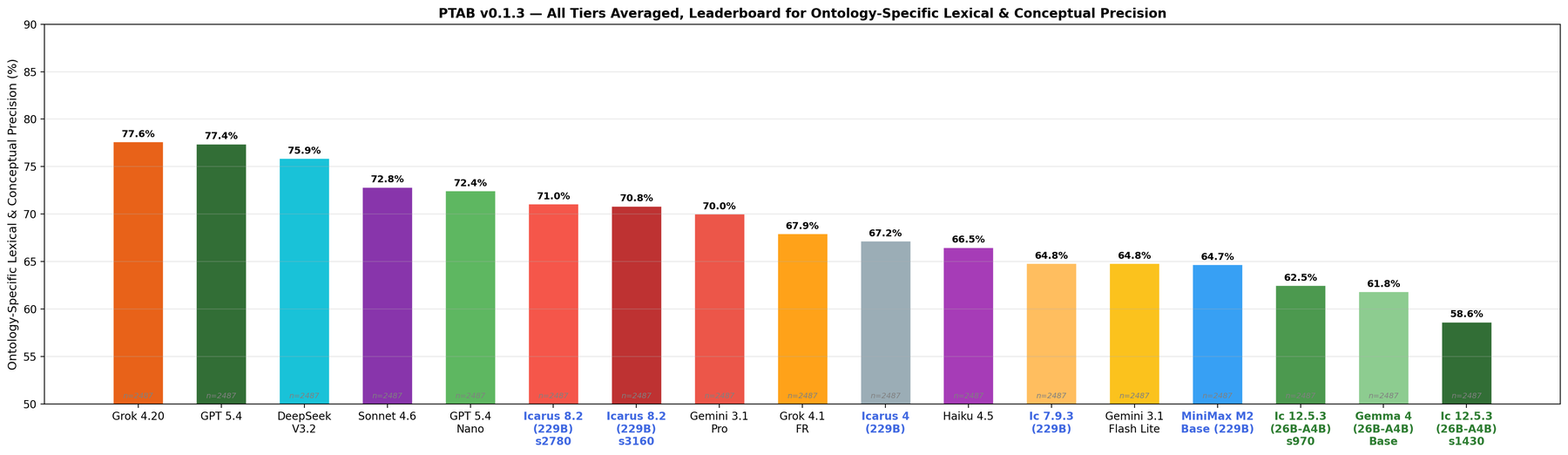
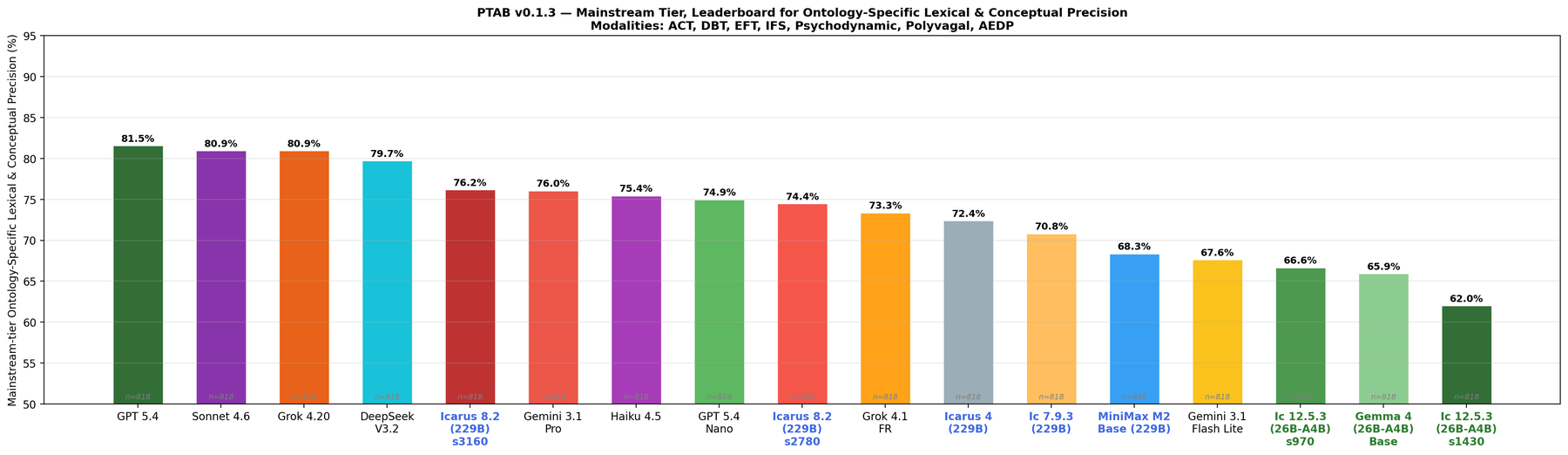
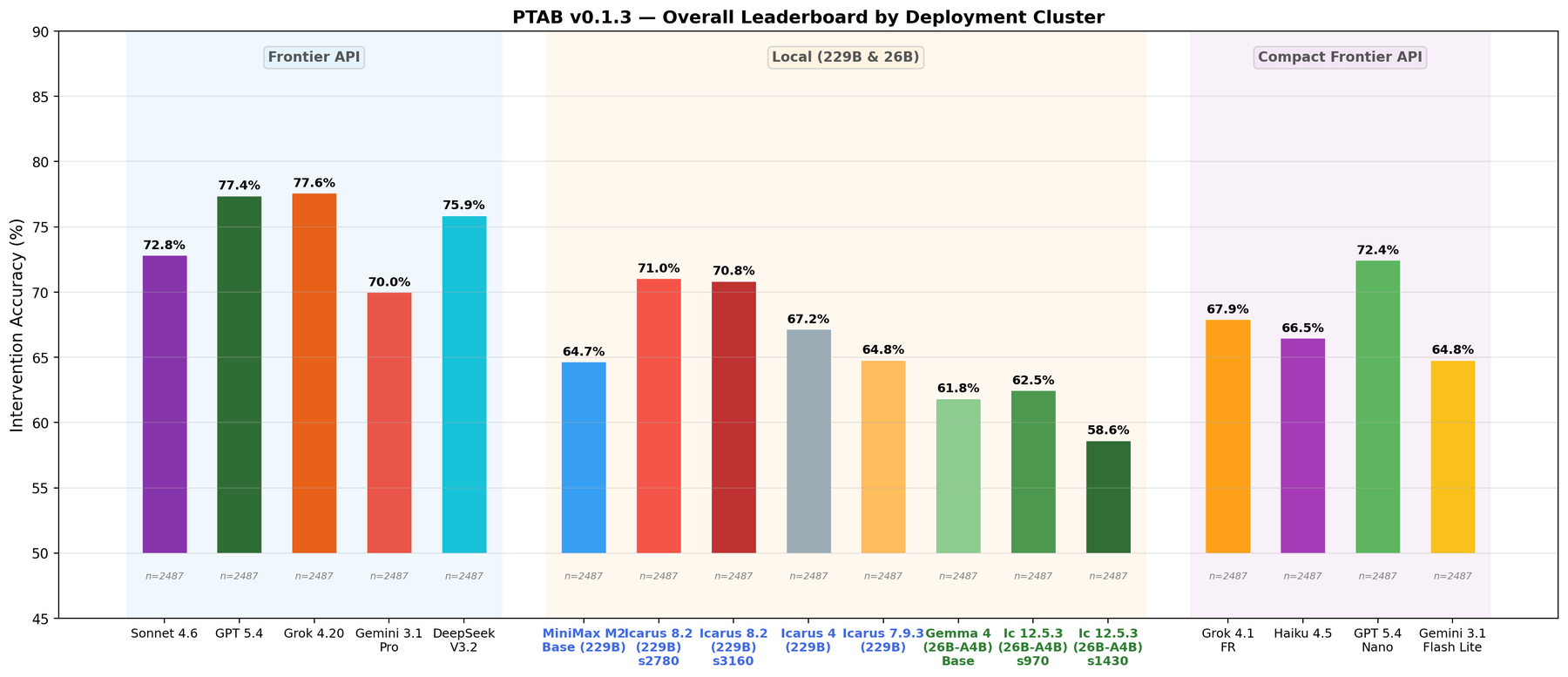
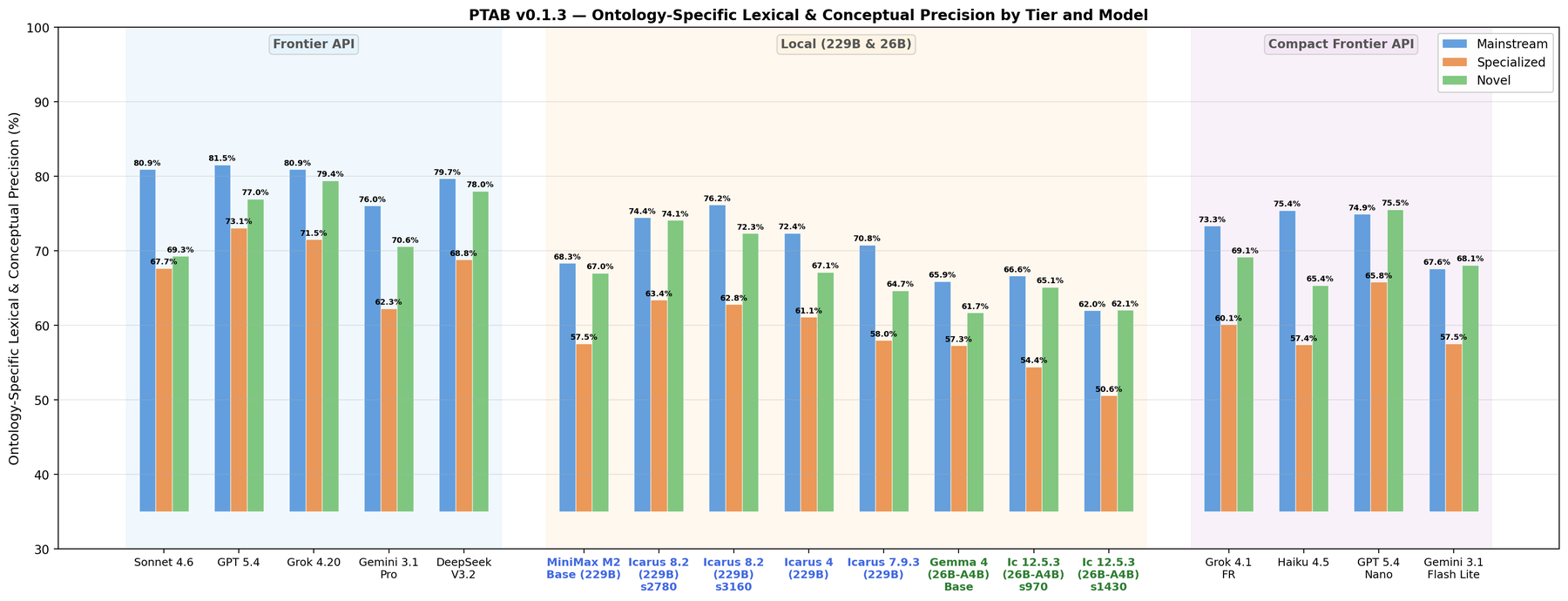
Icarus 4, Icarus 7.9.3, Icarus 8.2, Icarus 12.5.3 · domain-adaptive pretraining, evaluated
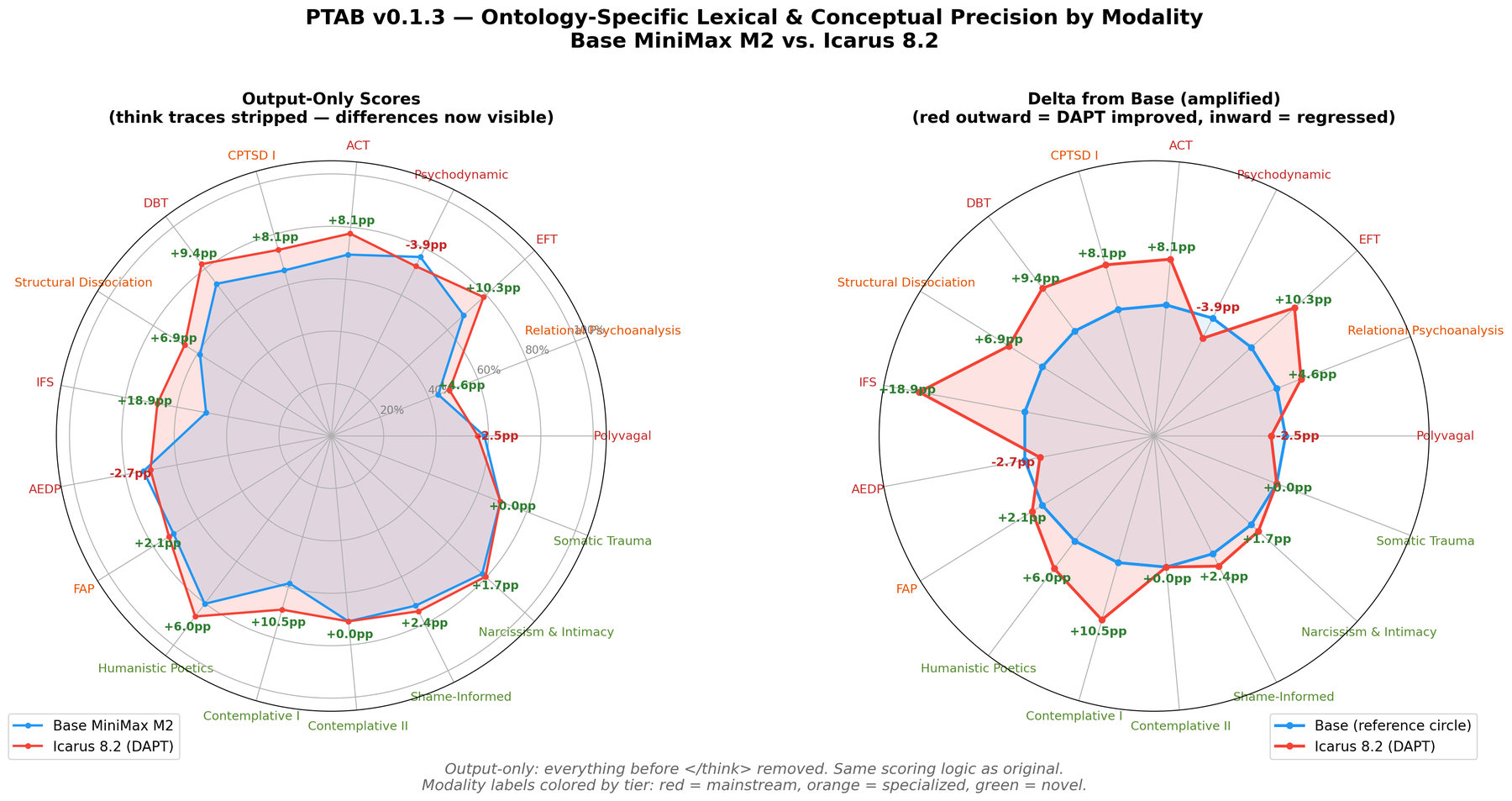
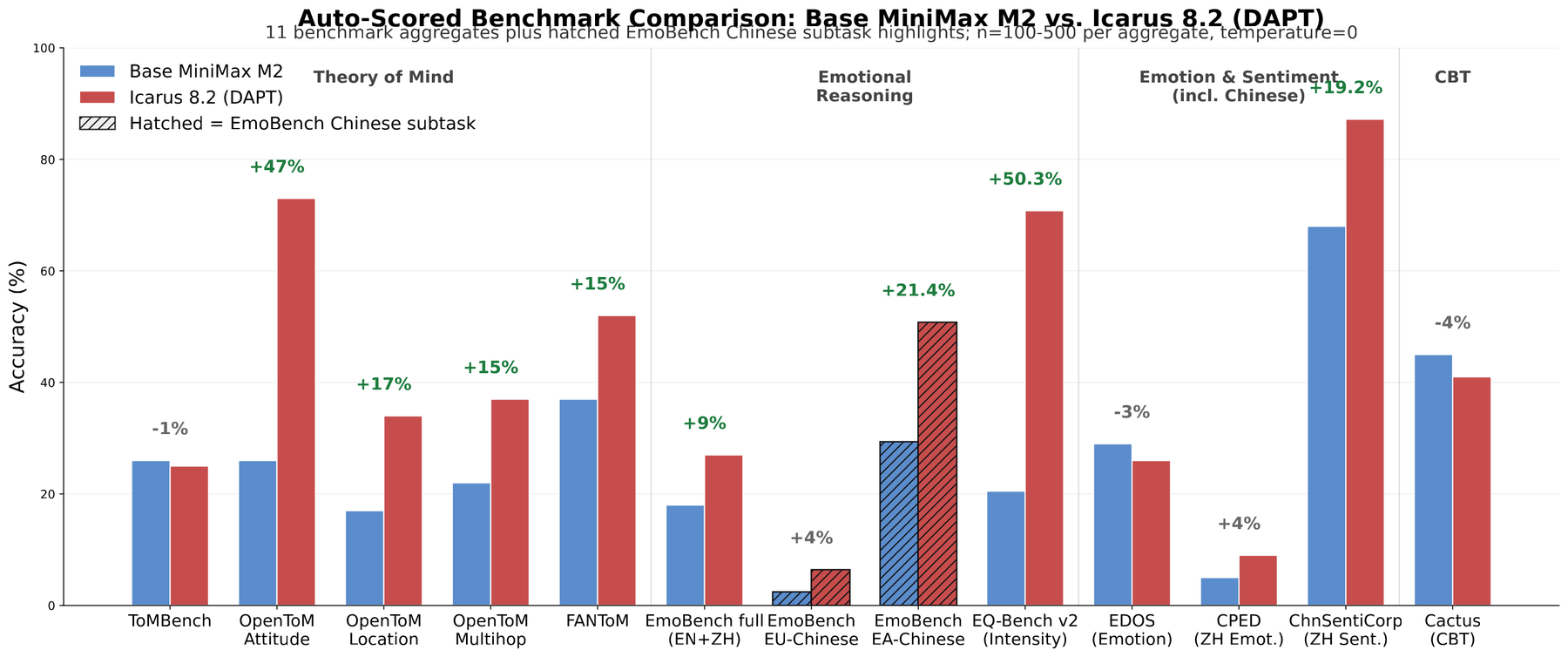
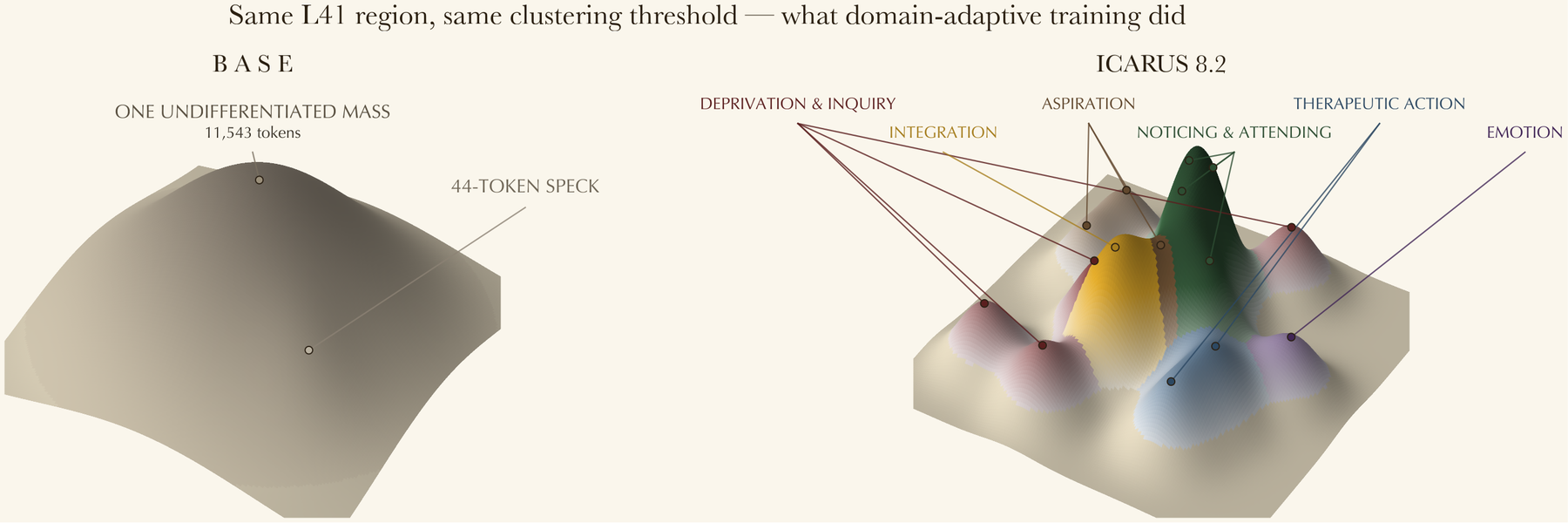
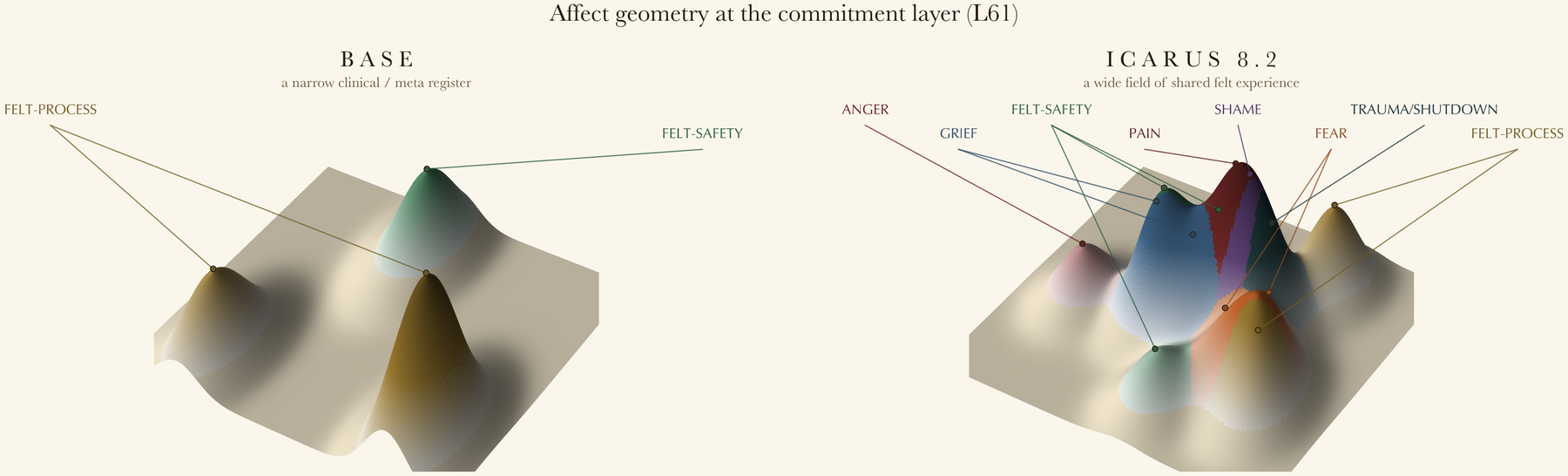
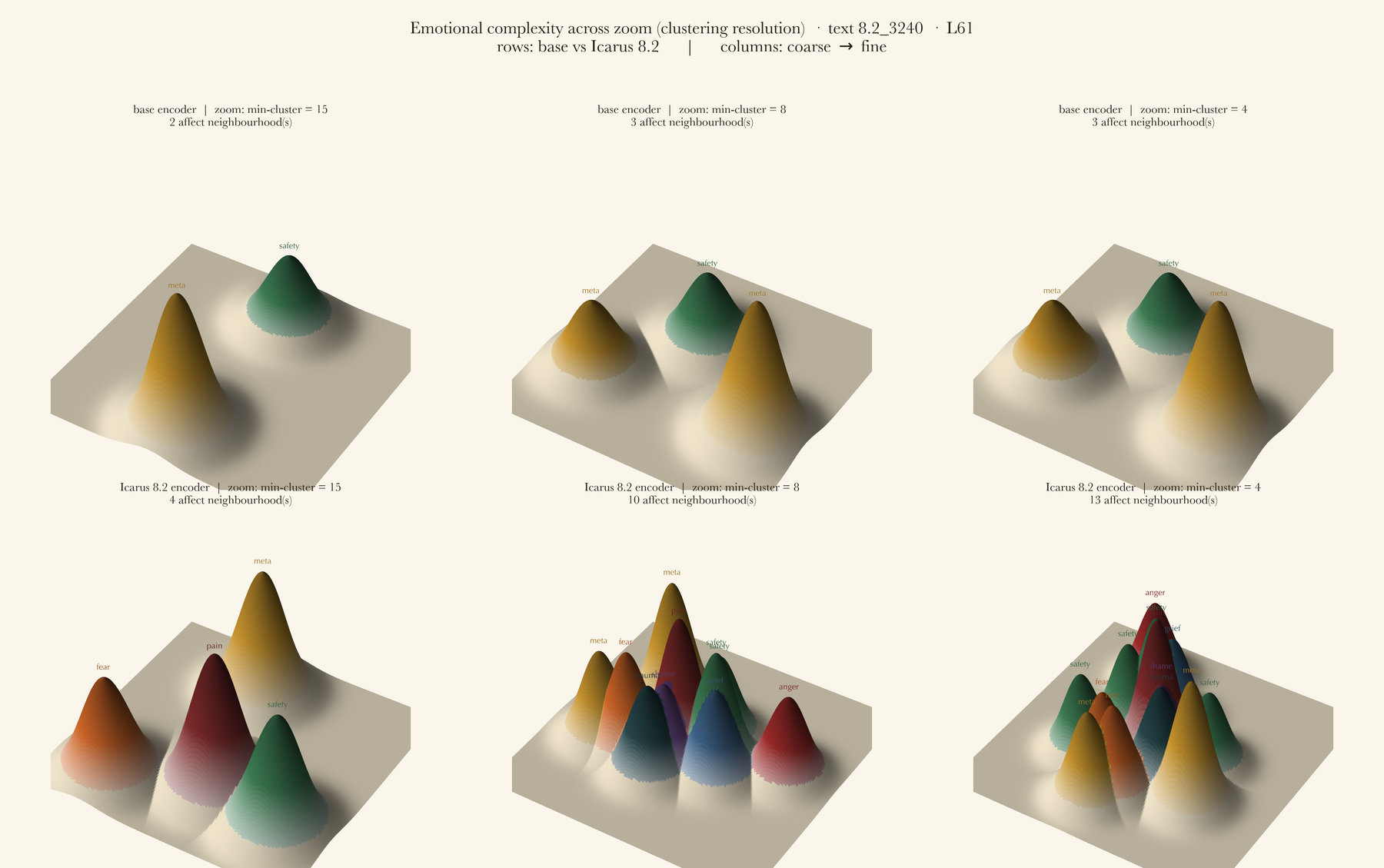
Icarus 8.2 is a domain-adaptively pretrained (DAPT) variant of MiniMax M2 on our bespoke therapeutic dataset (4.5b tokens, ~180k samples). The figures below report its evaluation — auto-scored benchmark performance and clinical-ontology lexical and conceptual precision relative to the base model — alongside a mechanistic-interpretability account of how the model's internal representation of affect reorganizes from the LoRA boundary (L41) to the commitment layer (L61).
compositions · instruments · objects
for two violins, viola, and cello
for cello trio
for cello trio
for harp & two violins
(Borrowed grace: the movement of dancers I admire, intentionally carried into my video edit of a ballet I wrote.)
(read along with a rough—and not-yet-engraved—draft of the score here:)
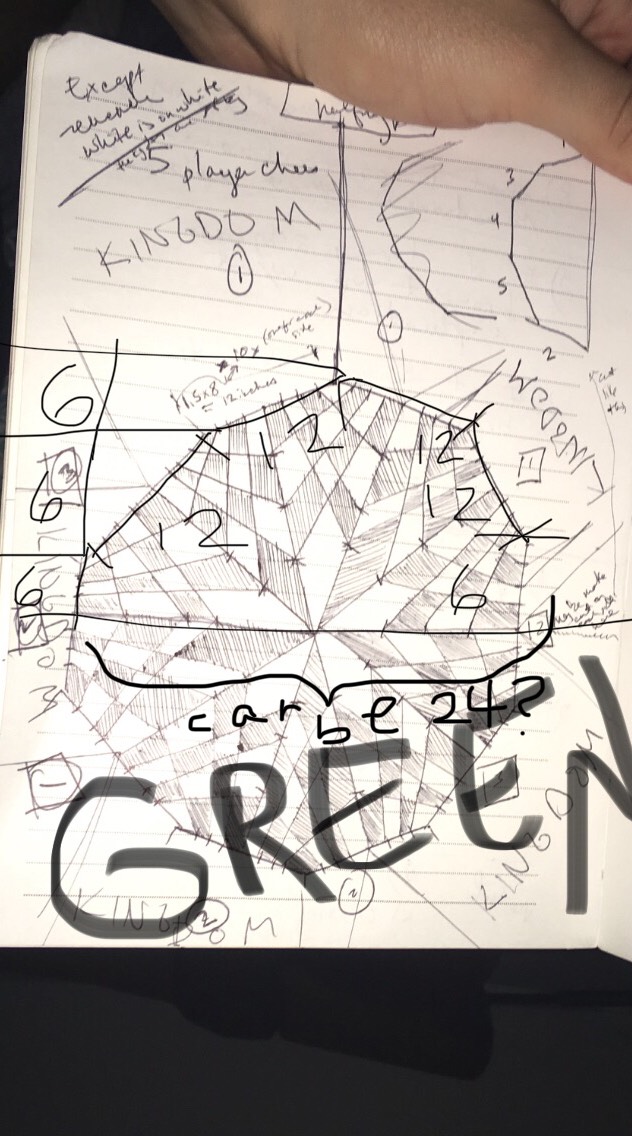
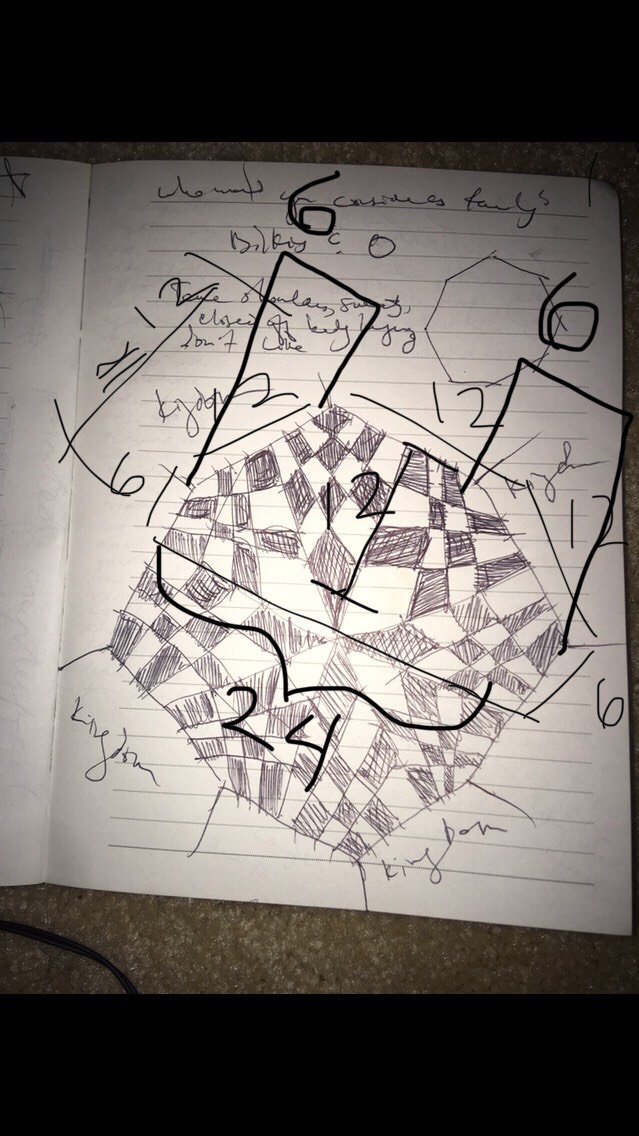
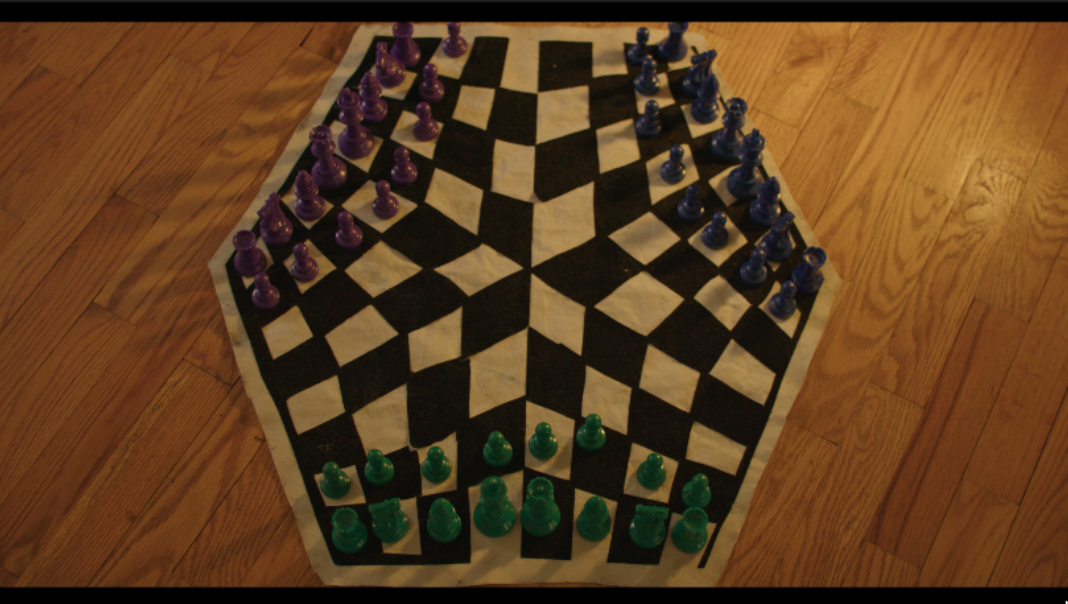
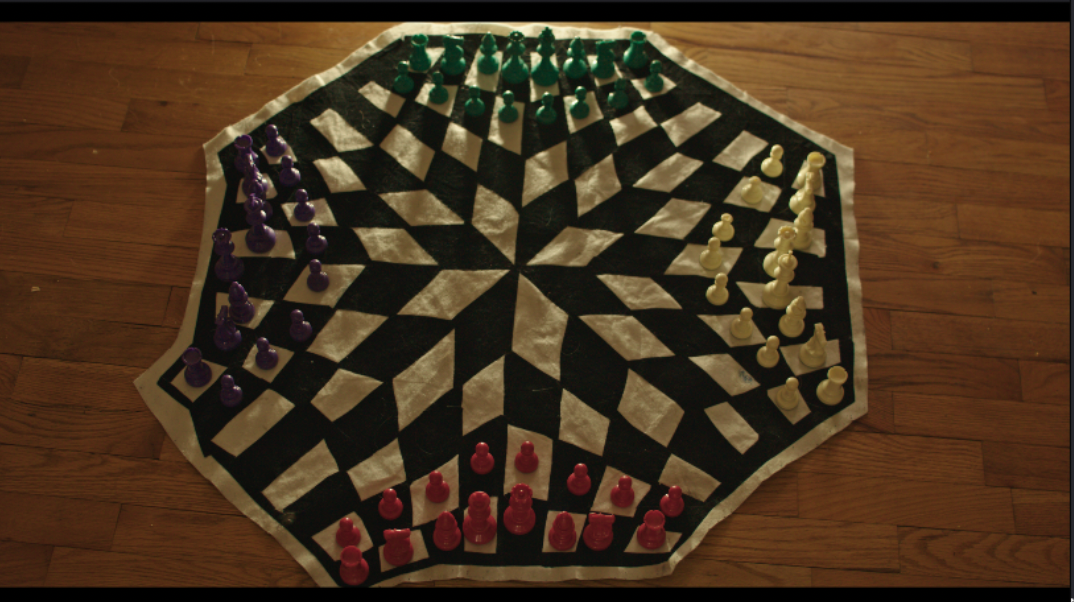
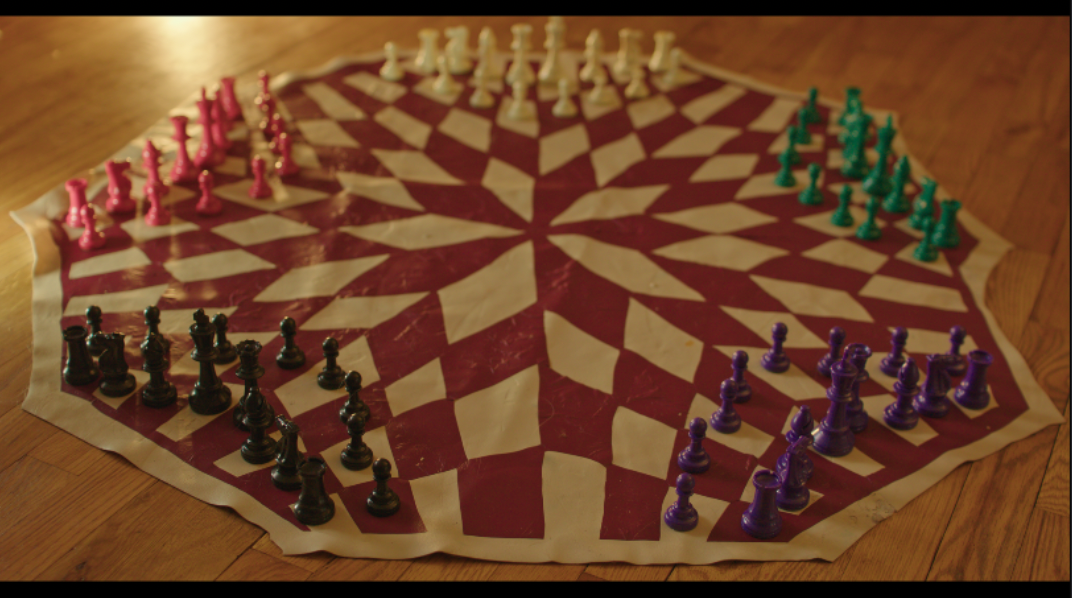
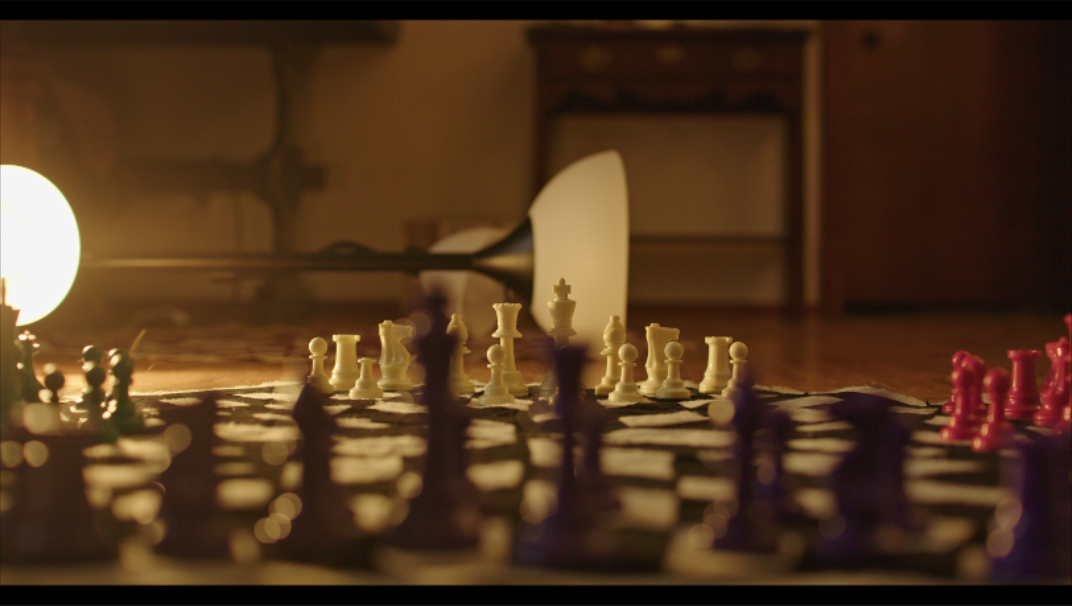
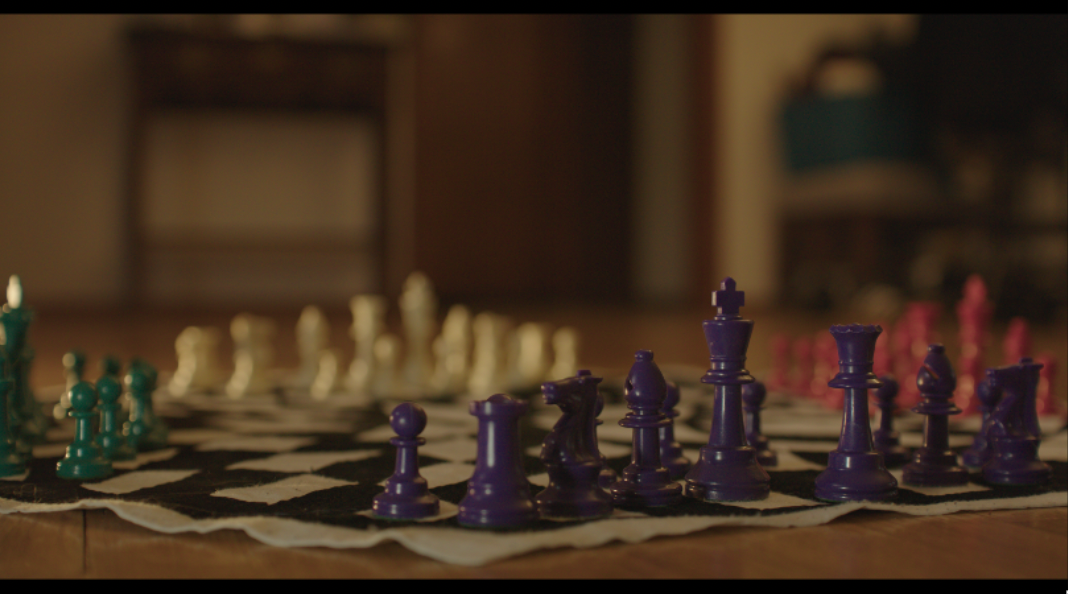
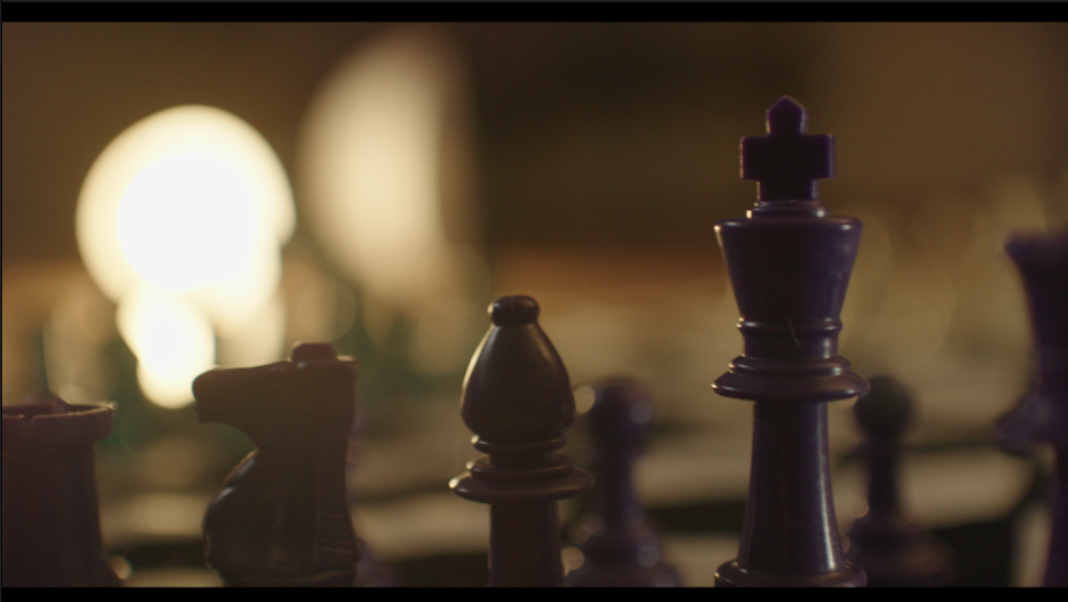
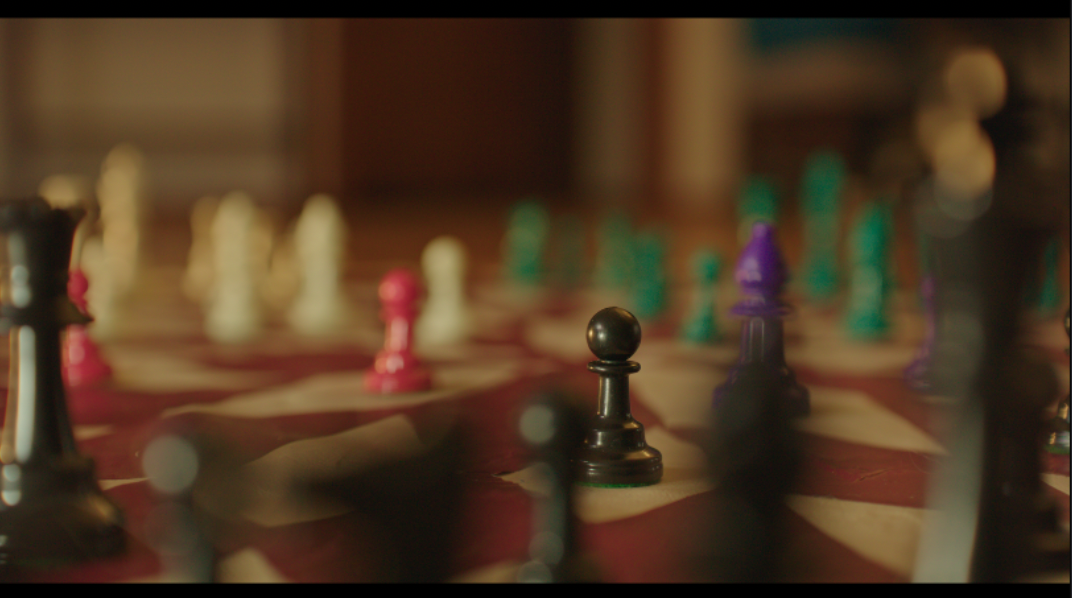
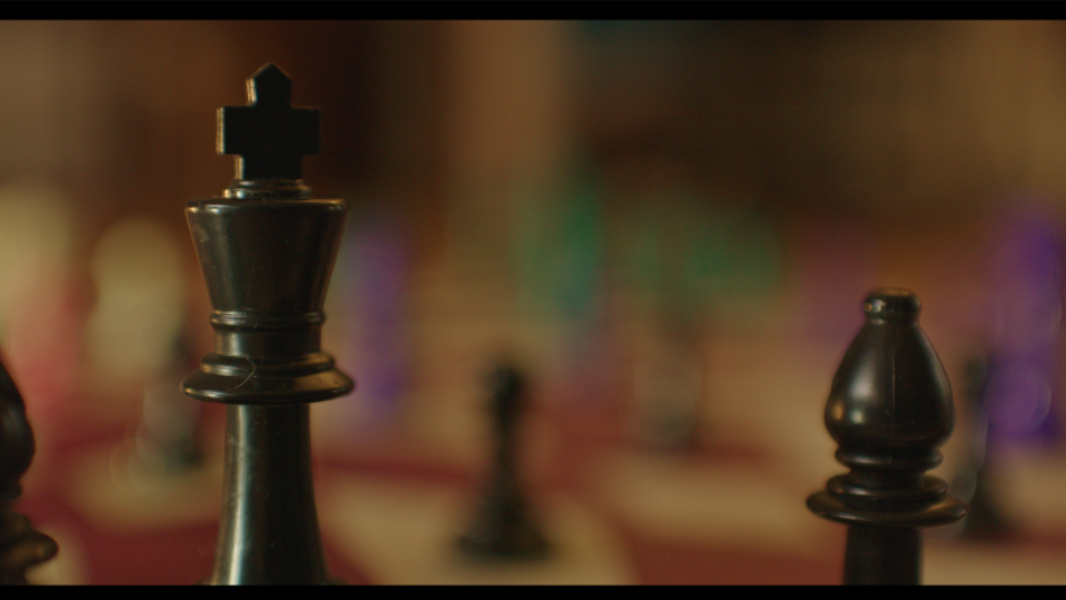
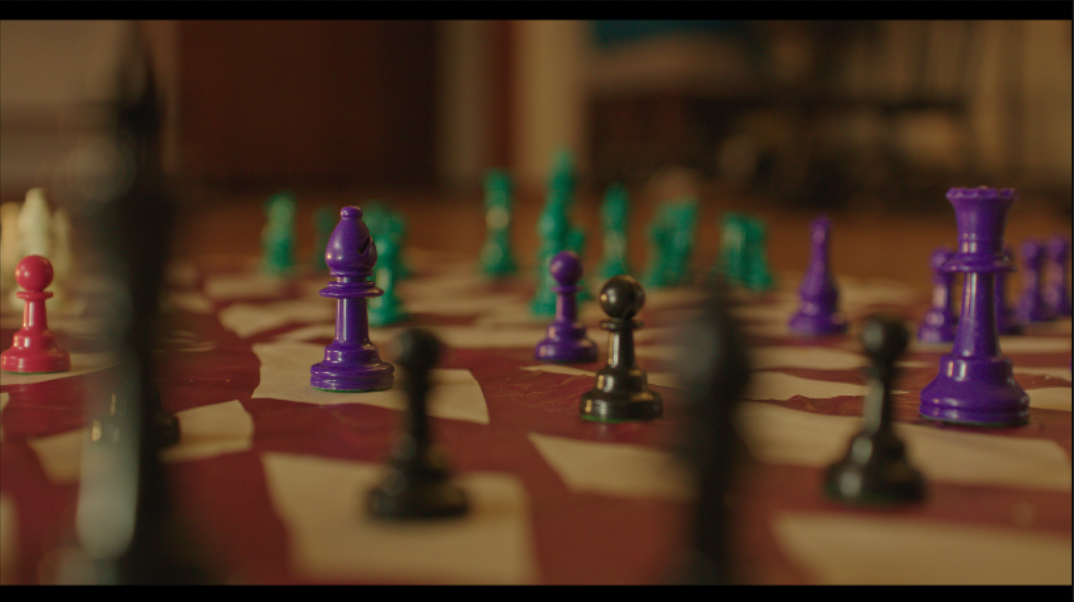
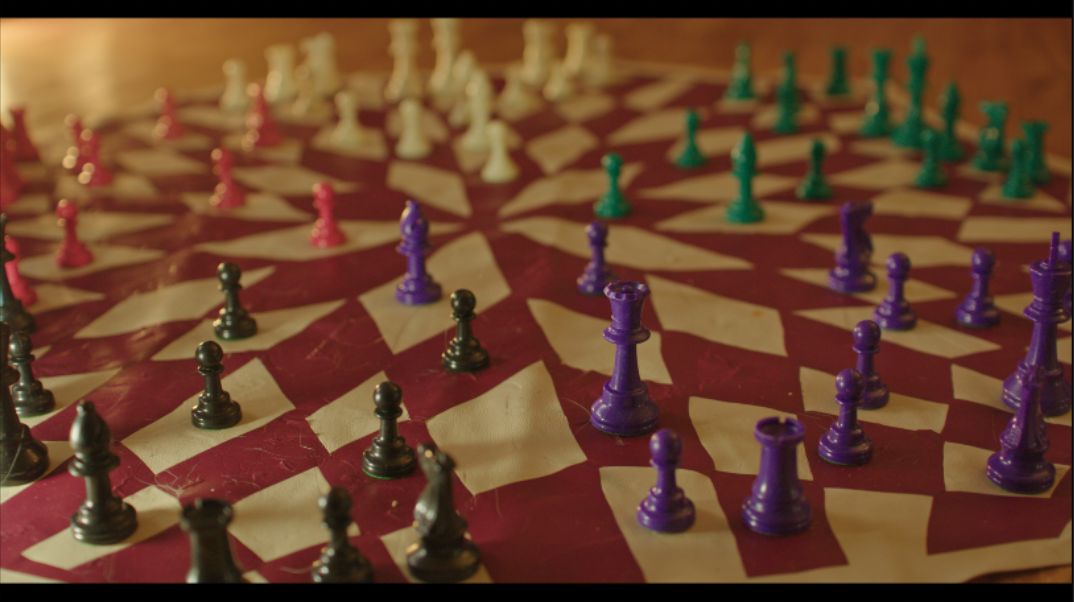
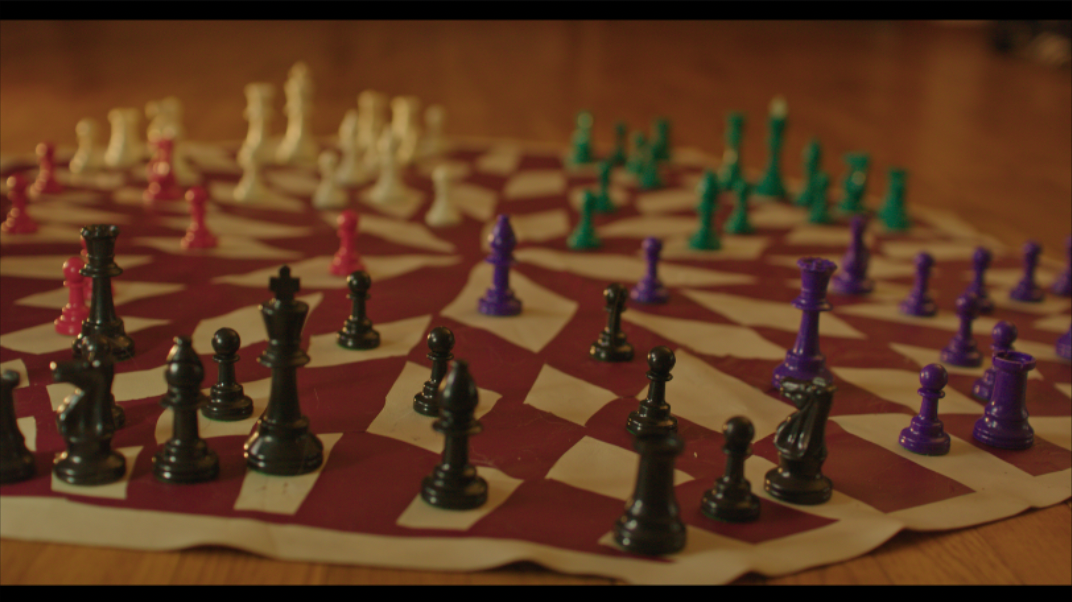
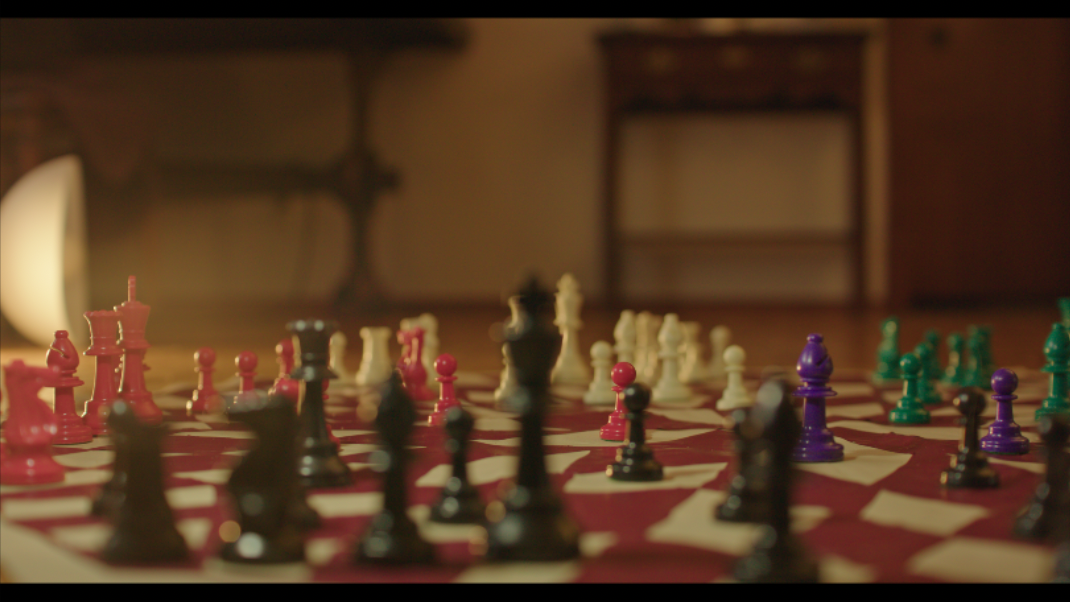
Tessellating non-standard polygons into playable boards for 3+ players.
all boards are designed for full-sized triple weighted regulation Staunton pieces
AI is exposing new human bottlenecks
When one part of a workflow becomes dramatically faster, the constraint simply moves elsewhere. Organizations then need more people to remove the next bottleneck and capture the value AI has unlocked.
Automation does not eliminate the need for human contribution. It often reveals how much more could be accomplished with it.
AI fluency will become one of the world’s most valuable skills
The emerging divide will not be between humans and agents. It will be between people who are highly fluent with AI and those who are not.
AI-fluent people will not be 10% more productive. In some forms of work, they could be 50x or even 100x more effective. They will imagine better uses for AI, orchestrate agents and apply judgment where machines still fall short.
These people will be scarce and enormously valuable.
— Jeetu Patel“The task of converting observations into numbers is the hardest of all, the last task rather than the first thing to be done, and it can be done only when you have learned, beforehand, a great deal about the observations themselves. You can, to be sure, achieve a very deep understanding of nature by quantitative measurement, but you must know what you are talking about before you can begin applying the numbers for making prediction…
“The risks of untoward social consequences in work of this kind are considerable. It is as important—and as hard—to learn when to use mathematics as how to use it, and this matter should remain high on the agenda of consideration for education in the social and behavioral sciences…
“The instruments devised for approaching nature… became increasingly precise and powerful, carrying… triumph after triumph, and setting the stage for the great revolution… There is no doubt about it: measurement works when the instruments work, and when you have a fairly clear idea of what it is that is being measured, and when you know what to do with the numbers when they tumble out…
“We have a wilderness of mystery to make our way through in the centuries ahead, and we will need science for this but not science alone. Science will, in its own time, produce the data and some of the meaning in the data, but never the full meaning. For getting a full grasp, for perceiving real significance when significance is at hand, we shall need minds at work from all sorts of brains outside the fields of science, most of all the brains of poets, of course, but also those of artists, musicians, philosophers, historians, writers in general… [There will be those, too, who] for their part, might take considerable satisfaction watching their scientific colleagues confess openly to not knowing everything about everything. And the poets, on whose shoulder the future rests, might, late nights, thinking things over, begin to see some meanings that elude the rest of us. It is worth a try.”
— Lewis Thomas, 1980